

Contents
Major national events often create periods of heightened uncertainty for corporate security teams. This year's America250 celebrations were no exception. Independence Day activities coincided with FIFA-related events across North America, increasing travel, drawing large crowds, and creating a more complex operating environment for organizations responsible for protecting people, facilities, executives, and operations.
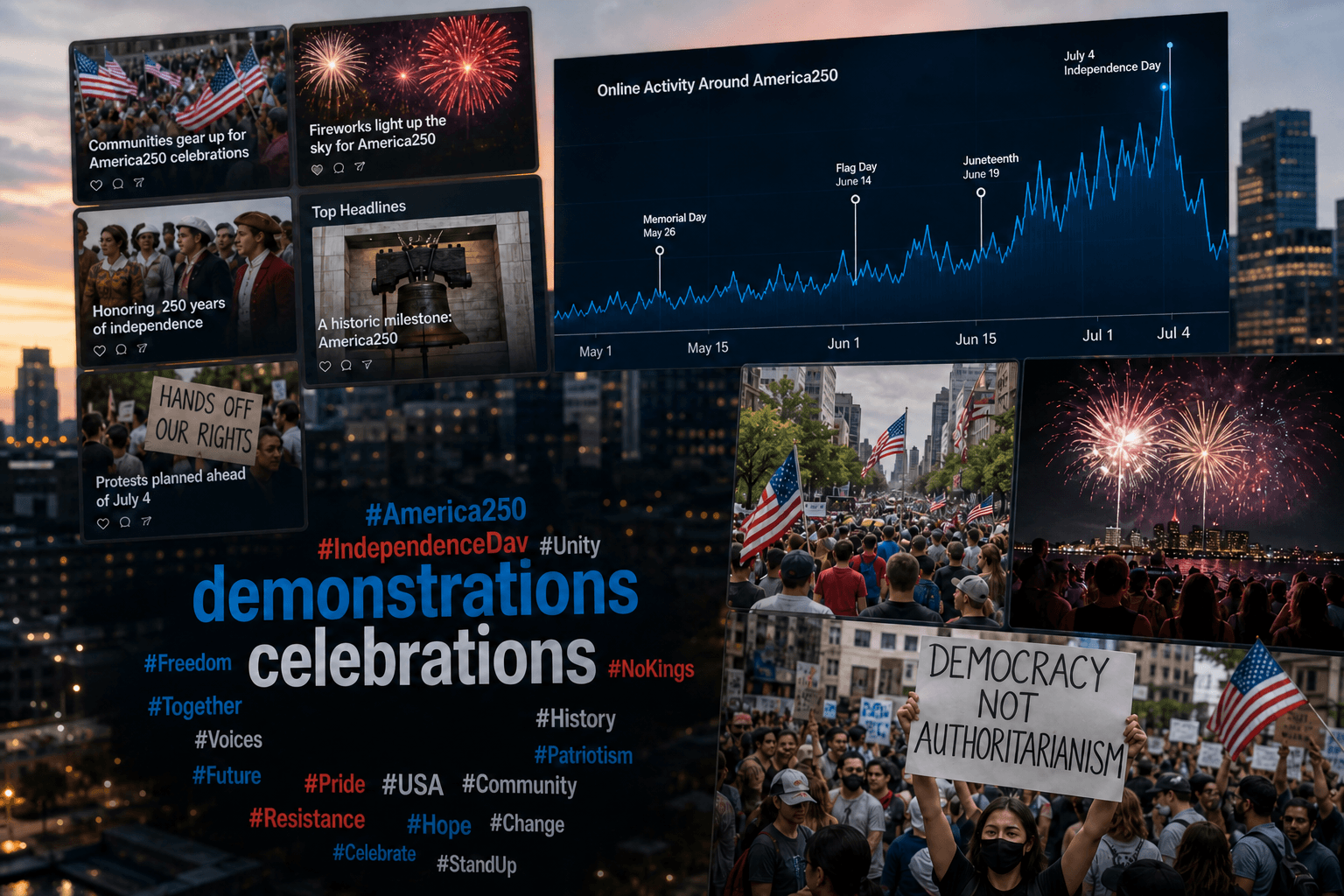
In the weeks leading up to July 4, the Liferaft platform monitored more than 15,000 publicly available posts across social media, news, blogs, and other open sources to understand how the online threat landscape was evolving. Monitoring focused on conversations related to demonstrations, protest activity, political mobilization, large public gatherings, and other developments that could influence security operations before and during the holiday weekend.
This report summarizes what the data revealed.
Activity Leading Into July 4
As July 4 approached, online discussion steadily increased across multiple platforms. Conversations centered on planned demonstrations, marches, immigration-related protests, fireworks celebrations, events in Washington, DC, and broader political narratives connected to America250.
The monitoring effort captured discussion from a diverse range of online sources, reflecting how quickly information surrounding large public events can spread across multiple communities. While English represented the majority of collected content, additional languages were also present, reinforcing the importance of monitoring beyond a single platform or geographic region.
The volume of discussion alone suggested elevated public interest. As is often the case with major events, however, volume did not necessarily correlate with operational risk.
Prominent Themes
Several themes consistently appeared throughout the reporting period.
Planned demonstrations and marches generated sustained discussion, particularly in larger metropolitan areas and around government buildings. Immigration-related protests and references to ICE also featured prominently, alongside conversations about public celebrations, fireworks, and large gatherings expected throughout the holiday weekend.
The dataset also contained politically charged rhetoric and calls for public mobilization. While some conversations reflected organized events, others consisted primarily of commentary, opinion, or the amplification of existing news coverage.
Taken together, the data illustrated how multiple narratives can develop simultaneously around a single national event, making context essential when assessing potential impacts.
Online Rhetoric Versus Observed Activity
One of the more notable observations from the reporting period was the difference between the level of online discussion and the level of widespread disruption that ultimately occurred.
In the weeks leading up to July 4, online conversations frequently referenced protests, demonstrations, and the potential for unrest. While localized incidents and planned demonstrations did occur in some locations, the widespread disruption anticipated in portions of the online conversation did not materialize.
This distinction highlights an important characteristic of open source intelligence. Elevated online activity should be treated as an indicator requiring additional analysis rather than as confirmation that events will unfold at the same scale in the physical world.
Throughout the reporting period, the Liferaft platform enabled analysts to continuously evaluate evolving conversations alongside reporting from multiple open sources, providing additional context as events developed.
Key Observations From The Data
Several noteworthy patterns emerged during the monitoring period that provide additional context around the online threat environment leading into America250, and while the volume of online discussion suggested the potential for widespread disruption, the operational outcome was shaped by several factors, including extensive security planning, coordinated law enforcement operations, and the disruption of credible threats before major events began.
Public reporting indicates that authorities investigated and disrupted at least one alleged attack targeting an America250 event, while major host cities implemented some of the largest security operations in recent years. Against that backdrop, the difference between online rhetoric and observed operational impact becomes easier to understand.
Key Observations
Organized Gatherings Dominated The Conversation
While concerns about civil unrest shaped much of the planning ahead of America250, the online conversation was more nuanced than anticipated. Terms such as 'rally,' 'march,' and 'marching' appeared more frequently than 'riot' or 'violence,' indicating that much of the discussion centered on organized public gatherings rather than reports of widespread disorder.
Demonstrations remained an important component of the online conversation, but they represented only one part of a much broader operational picture.
Multiple Narratives Developed At The Same Time
The collection effort revealed that America250 was not defined by a single narrative. Liferaft analysts simultaneously tracked conversations related to patriotic celebrations, fireworks, planned demonstrations, immigration-related protests, political activism, travel, and localized public safety concerns.
These conversations evolved independently and often overlapped geographically, reinforcing the importance of evaluating developments within their broader context rather than relying on individual keywords or isolated reports.
Conversations Spanned Multiple Online Communities
Discussion surrounding America250 was distributed across several online platforms, including fringe alt-social sites. Assessing multiple sources allowed our analysts to compare how narratives developed across different online communities, identify emerging themes, and validate reporting as events unfolded.
Elevated Online Activity Did Not Translate Into Widespread Operational Disruption
Perhaps the most significant observation from the reporting period was the difference between the level of online conversation and the operational impact ultimately observed.
The data reflected sustained discussion around demonstrations, political activism, and the potential for unrest. While localized incidents and planned demonstrations occurred in several locations, the widespread disruption anticipated in portions of the online conversation did not materialize.
From an intelligence perspective, this reinforces the importance of combining conversation volume with context, corroborating information across multiple sources, and continuously assessing how online narratives relate to real-world activity.
Final Observations
America250 generated significant online discussion across thousands of publicly available sources before and during the July 4 holiday period. The data reflected elevated public attention surrounding demonstrations, political activism, public celebrations, and other activities associated with one of the largest national events of the year.
Perhaps the most significant observation was the difference between the scale of online conversation and the level of real-world disruption that ultimately occurred. While elevated rhetoric remained a defining characteristic of the reporting period, context provided a more accurate picture of the operational environment than conversation volume alone.
Maintaining visibility into evolving online discussions remains an important component of situational awareness during major events. Throughout the America250 reporting period, the Liferaft platform provided analysts with continuous visibility into emerging conversations, helping distinguish developing issues from background noise as events unfolded.
As planning begins for future large-scale events, including major sporting events, elections, and national celebrations, the ability to continuously monitor and analyze open source information will remain an important part of understanding an evolving risk environment.
